Possibly, but the evidence is mixed, and nobody can promise it. Some research finds that higher pay is linked to better data. Other work has found pay changes how much people do more than how well they do it. What fair pay does do is give people a reason to take part and stay.
We can describe our own pay model exactly. We can't prove that it improves your results, and we don't claim to.
What the research says
Studies of online participants point in different directions:
- Earlier work on Amazon Mechanical Turk found that pay affected the quantity of work more than its quality. Those studies generally looked at rates below minimum wage.
- A 2015 study by Litman, Robinson and Rosenzweig, published in Behavior Research Methods, compared US and India-based workers. It found that data quality among India-based workers was affected by compensation, at rates set around the minimum wage there. It also found that quality was lower for India-based than for US workers even when pay was set well.
Treat these as pointers to the research, not a full review of it. Pay is one factor among many. Instructions, task length, screening and checks matter too.
What we can say
Fair pay doesn't guarantee good answers. It does remove one reason to rush: a person paid so little that carelessness is the rational choice.
We also think it is simply right. People who answer questions deserve clear pay that they can check.
How 50heads splits the money
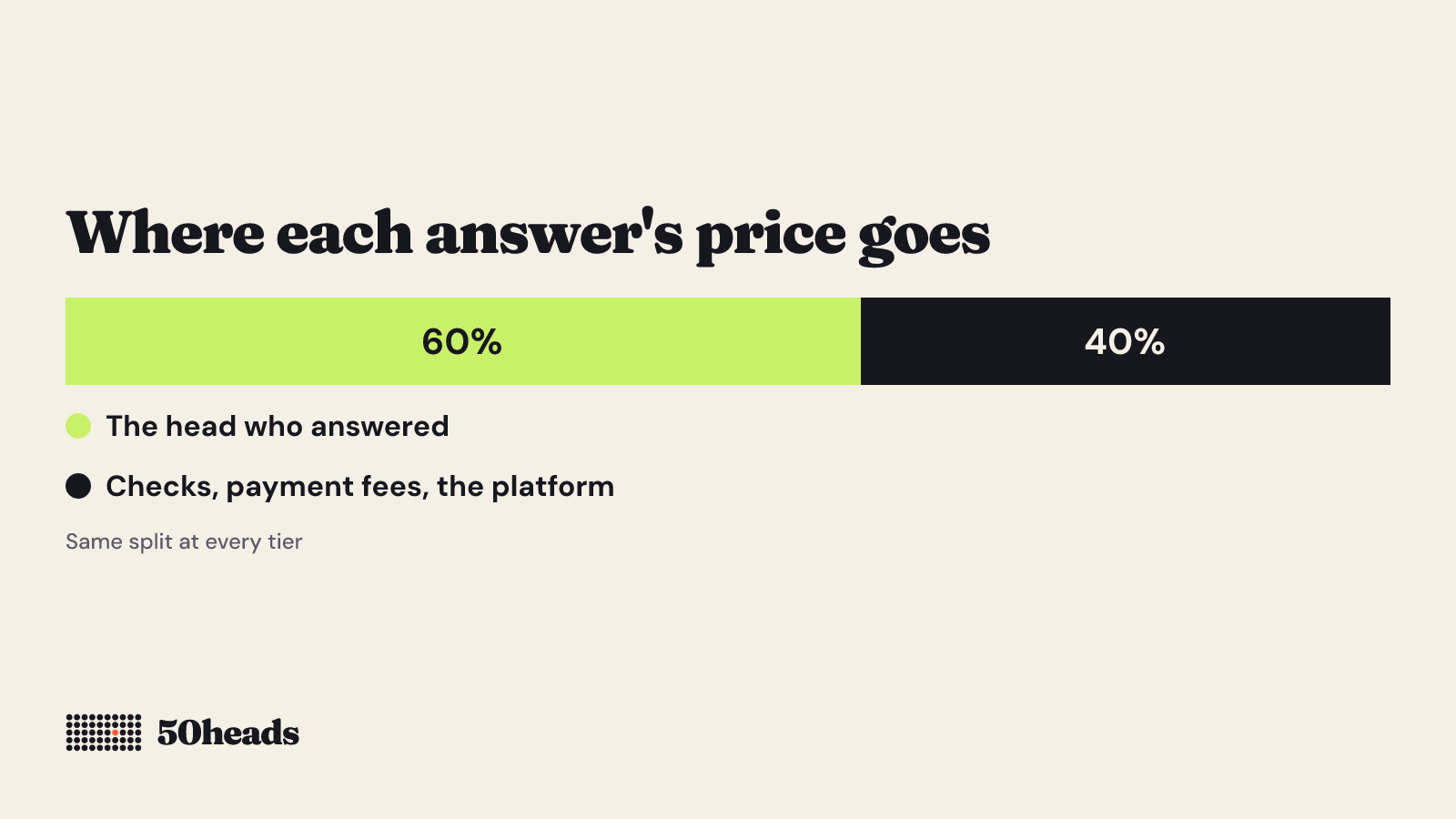
A requester pays $0.25 for a Tier 1 answer. Heads, the people who answer questions on 50heads, get 60% of every answer's price. For a Tier 1 answer, that is $0.15.
The rest covers:
- the device and phone checks on every answer;
- the ID provider for Tier 2;
- payment fees;
- servers and support;
- the people who build and run 50heads.
| Tier | A requester pays | A head earns |
|---|---|---|
| Tier 1 | $0.25 | $0.15 |
| Tier 2 | $0.55 | $0.35 |
| Tier 3 | $1.05 | $0.65 |
These are for a short pick-one question. Longer questions, images and rush answers cost more and pay more in proportion.
What else we commit to
Our fair pay statement sets these out:
- the same rate in every country, before currency conversion;
- pay shown before the head answers;
- a floor: a Tier 1 answer never pays less than $0.15;
- at least 30 days' notice in the app before any change that lowers pay;
- a person decides appeals, and we publish the numbers.
See the rates in local currency on pay rates by country.
What it is not
Answering questions is not a full-time income. Questions come in bursts, and how much a head can earn in an hour depends on how many are waiting. We don't promise an hourly rate.
What this means for a requester
- You don't pay extra for fair pay. It is built into the per-answer price.
- Your result depends mostly on your question, who you asked and how many answered.
- Pay is one reason to trust a panel more, alongside identity checks and published appeals. See what makes an online research panel high quality.
Next step
See what your question would cost and what the heads who answer it earn. See pricing and use the estimator. It charges nothing.