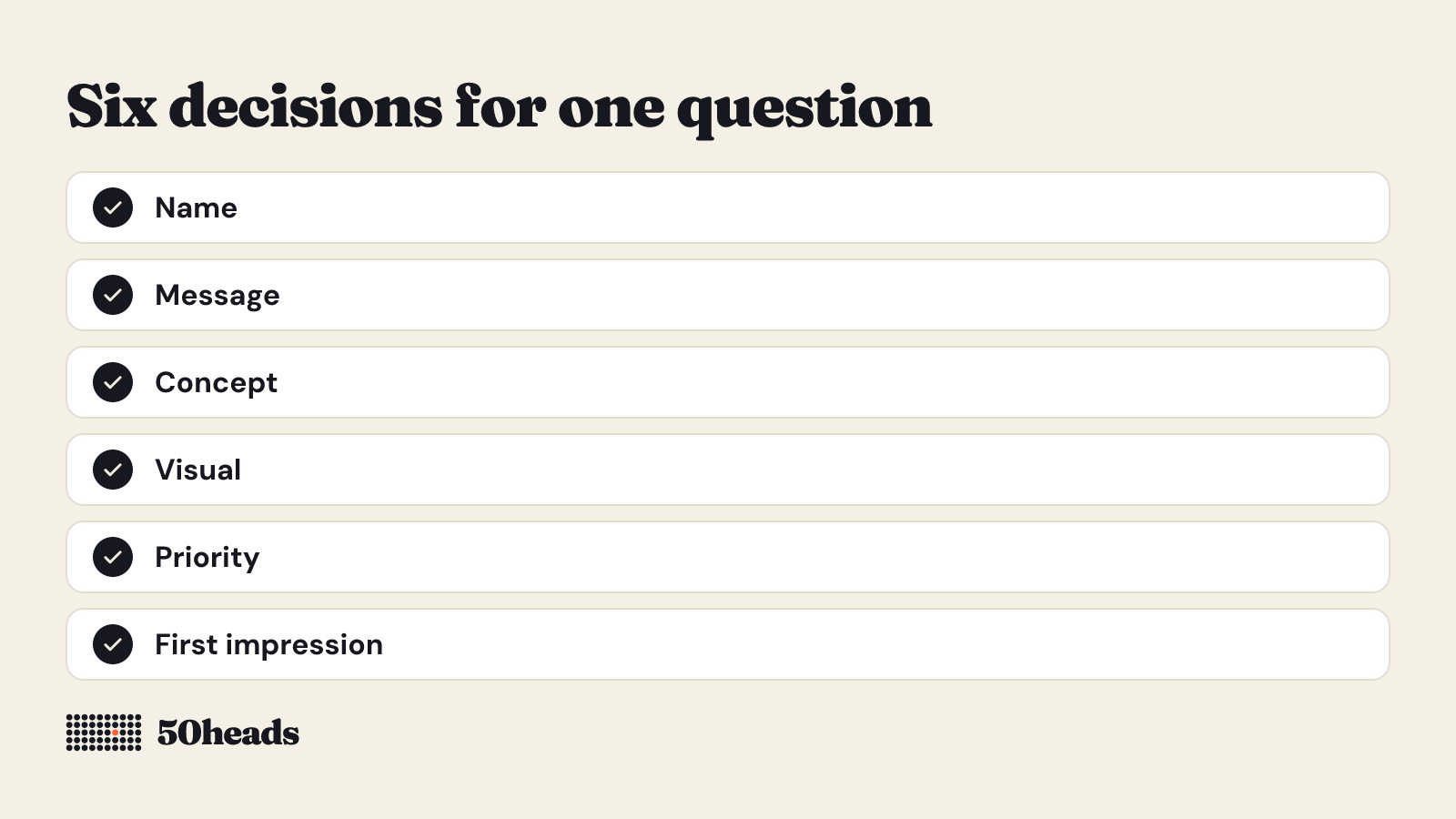
One short question suits decisions where you have a few options and people's choice matters. Six common ones are the name, the message, the concept, the visual, the priority and the first impression. For each, here is the question shape and the point at which to stop and use another method.
Fast feedback is a way to narrow choices. It is not a replacement for talking to customers.
The six decisions
| Decision | Question shape | Format on 50heads |
|---|---|---|
| Name | Which would you trust, remember or expect to do this job? | Pick one |
| Message | Which line is clearer? | Pick one |
| Concept | Which would you be most likely to use? | Pick one |
| Visual | Which would you tap, or notice first? | A or B images |
| Priority | Which matter most to you, in order? | Rank them |
| First impression | What do you think this is for? | Pick one |
Each question goes to its own group of heads, the people who answer questions on 50heads. Don't treat results from different questions as coming from the same people.
1. Name
Ask about one quality: trust, fit or memorability. Keep each name within 40 characters.
Don't use it when the name must be legally available or work in other languages. Check those separately. See how to test a product name.
2. Message
Compare two to four lines for clarity. Ask "Which line is clearer?" before "Which makes you want to know more?"
Don't use it when the message depends on the page around it. People will see it with an image and a button.
3. Concept
Put two to four concepts in a line or picture each. Ask which they would be most likely to use.
Don't use it to find out whether people will pay. Choosing is free. See how to test a product idea.
4. Visual
Use an A or B images question, which takes exactly two pictures. Ask about one quality, such as which they would notice first.
Don't use it to judge print quality or how a design feels. Heads see images on a phone.
5. Priority
Use a Rank them question, where people drag options into order. You see the average rank of each option. Ranking is priced at 1.3 times the base price.
Don't use it with more than eight options. Ranking takes more effort than choosing, so keep the list short.
6. First impression
Show the product and ask what people think it is for, with a few possible answers. If most pick the wrong one, your page isn't clear.
Don't use it as the only test of usability. It shows what people think at a glance, not whether they can use it.
How to keep it organized
In Projects, you can group questions by what you are trying to find out, so each round sits next to the last. Templates are ready-made question formats at a fixed price, which save you setting up the same shape again.
What fast feedback does not tell you
- It shows what this group chose, not what all your customers think.
- It doesn't explain why. Ask 20 Tier 2 heads, who have also passed an ID check, for a short reason.
- It doesn't replace interviews, usage data or sales.
Next step
Pick the decision in front of you this week and write it as one question. See pricing and try the estimator. It charges nothing. Fifty Tier 1 answers to a short question cost $13 and typically take about ten minutes.