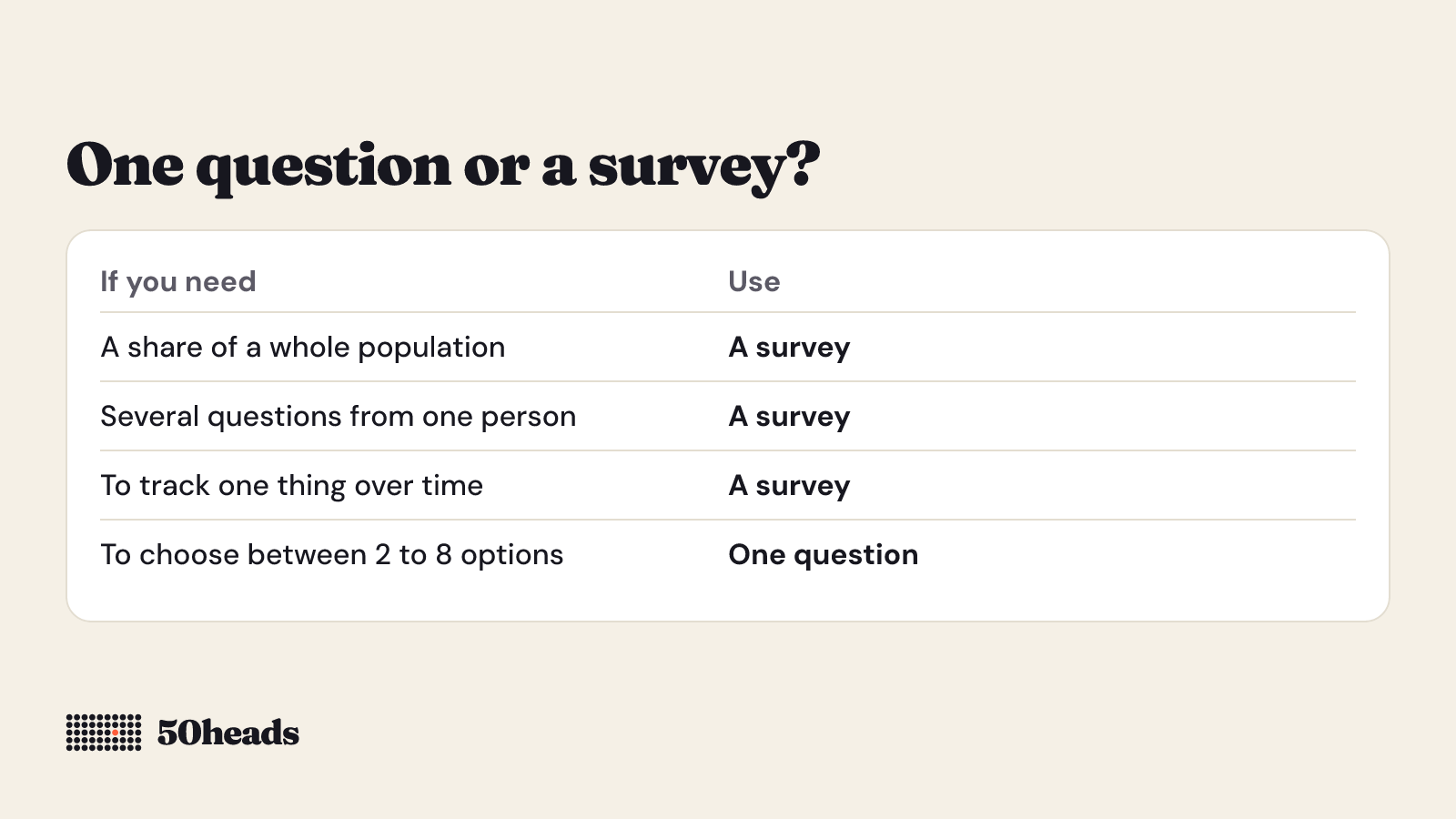
Use a poll when you need to choose between a few options and one answer will settle it. Use a survey when you need to understand why, how much, or how different groups compare. If you can write the decision as "A or B?", start with one question.
A poll here means one short question with a few options. A survey means several questions answered by the same person.
When one question is enough
One question works when three things are true:
- You have a real decision. You are choosing a name, a headline, a thumbnail or a line of copy.
- The options are on the table. You already have two to eight candidates.
- One answer will change what you do. If the result wouldn't change your choice, don't ask.
Examples that suit one question:
- Which of these three names would you trust with your savings?
- Which thumbnail would you tap?
- Which of these two lines is clearer?
- Would you order from this menu? Yes, mostly or no.
When you need a survey
Use a longer survey when the answer is a picture, not a choice. For example:
- You need to know why. One question tells you what people picked. It rarely tells you the reason.
- You need to compare groups. Do new customers answer differently from old ones? That needs more answers and more questions per person.
- You need to measure something over time. Tracking satisfaction every quarter needs the same questions each time.
- The answer depends on an earlier answer. If question two only makes sense after question one, you need a flow.
- You need an estimate for a whole population. A small, quick poll shows what this group chose. It doesn't tell you the share of everyone.
50heads does not run multi-question surveys. For those, use a survey tool or a research panel.
A short decision list
Go through these in order. Stop at the first "yes".
- Do you need to estimate a share of a whole population? Use a survey.
- Do you need several questions answered by the same person? Use a survey.
- Do you need to track the same thing over time? Use a survey.
- Do you have two to eight options and one decision to make? Ask one question.
- Not sure what the options are yet? Talk to a few customers first. Then come back to step 4.
Why a single question can give a clearer answer
A short question is easy to answer well. Heads, the people who answer questions on 50heads, answer on a phone in about five seconds. There is little to misread and nothing to abandon halfway.
A single question also costs less and comes back sooner. On 50heads, fifty Tier 1 answers cost $13 and typically take about ten minutes. That time is typical, not guaranteed. You can ask again tomorrow with a changed question, which is often more useful than one long study.
What the result does and does not mean
A poll shows what this group chose in this question. It does not show that the winner is best, or that a different group would choose the same.
50heads gives each result one plain sentence: the leader, the margin in percentage points and how strong the lead is for the number of answers. For example, "Menu B wins by 36 points. Confidence high." Confidence means how strongly the answers favor the leader. It is not certainty. See what confidence means.
A leading question can also give a strong result for the wrong thing. Our guide to writing questions that get clear answers covers how to avoid that.
A worked example
You are choosing between two names for a savings app: Northway and Keel.
- Write the question: "Which name would you trust with your savings?"
- Add the two options. Add "Neither" if it is a real possibility.
- Ask fifty Tier 1 heads, which means people with a verified phone.
- Read the result. Say Northway got 33 answers and Keel got 17. The result line says which led, by how many points, and how strong the lead is.
You now have a direction. You do not yet know why Keel lost, or whether trust is what matters. If that matters, ask the follow-up to 20 Tier 2 heads with free text, which means people who have also passed an ID check and can write a short reason.
The numbers in this example are made up to show how to read a result. They are not from a real study.
Next step
If you have a choice to make, write it as one question and see the price first. See pricing and try the estimator. It charges nothing. To see the steps from question to result, read how it works.