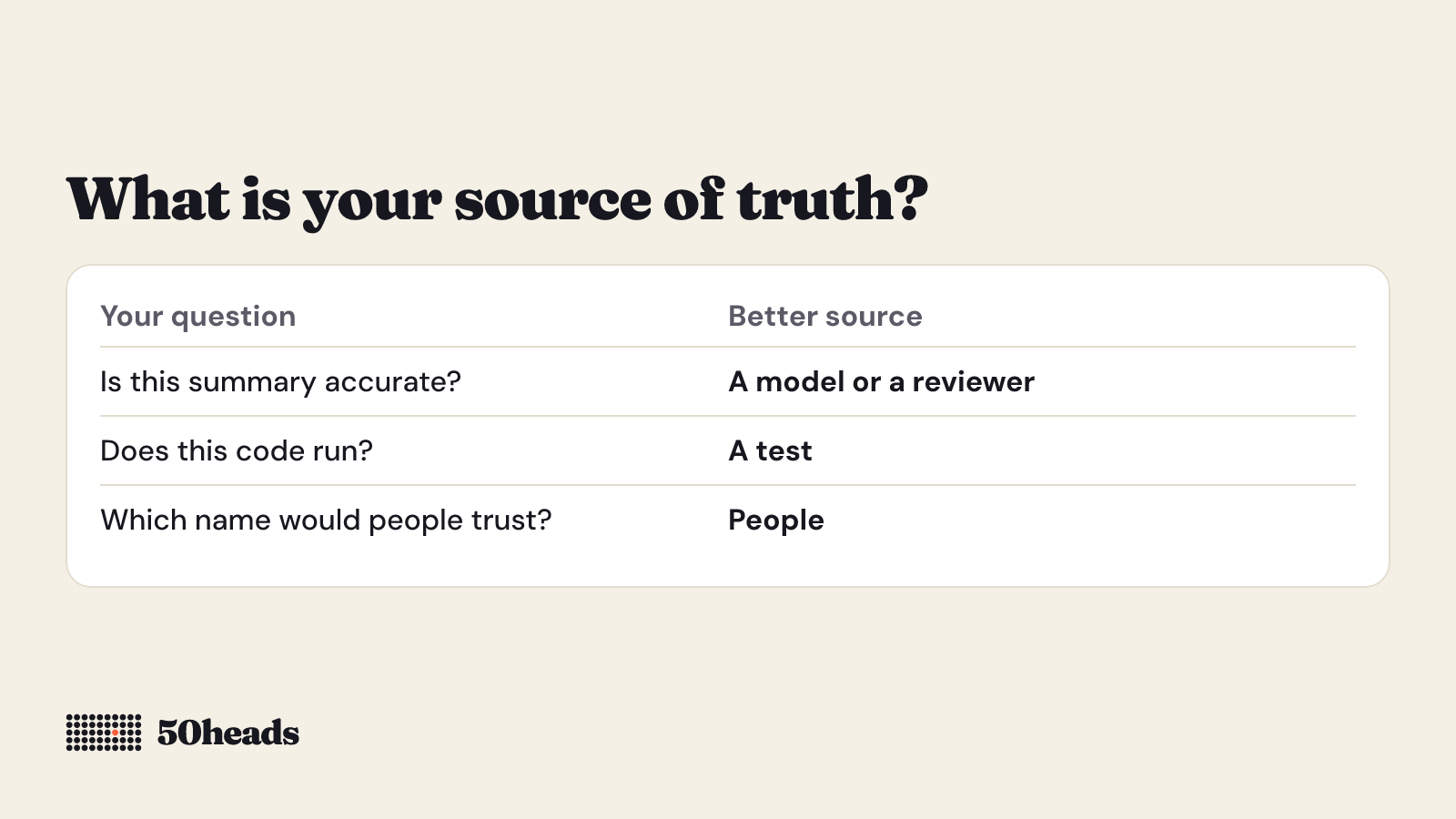
Use an AI model when the answer can be checked against language, logic or facts. Ask real people when the answer is what people prefer. A model can describe how a typical person might react. It cannot tell you what these people chose.
The test is simple. Ask what your source of truth is.
Three kinds of source of truth
| Your question | The source of truth | Better source |
|---|---|---|
| Is this sentence grammatical? Is this summary accurate? | Language rules and the text itself | A model, or a careful human reviewer |
| Does this calculation hold? Does this code run? | Logic, a test or a document | A model, a test suite or a specialist |
| Which of these names would people trust? | What people choose | People |
If you can check the answer without asking anyone, you don't need a panel. If the answer is a choice that real people make, you do.
Where a model is useful
A model can help you before you ask anyone:
- draft ten name ideas, then cut them to four;
- spot unclear wording in a question;
- summarise the written reasons people gave afterwards;
- write the code that calls an API.
These are jobs where the output can be reviewed by you.
Where a model is not your customer
A model can imitate how a person might respond. That is not the same as measuring people. Three limits matter:
- It has not chosen anything. A model's answer is generated, not decided by a person with a budget, a phone and a mood.
- It can sound sure and be wrong. A confident explanation of why people prefer option B is not evidence that they do.
- It cannot be a new group. If your customers are parents in Leeds, a model has not met them.
For taste, trust and first impressions, the thing you want to measure is a human reaction.
A short decision list
- Can you check the answer against a document, a test or a rule? Use a model or a test.
- Is the answer what a group of people would choose? Ask people.
- Do you need both? Use the model to prepare the question, then ask people.
Using both together
Many teams combine them:
- A model drafts six headline options.
- You trim them to three.
- People choose between the three, on their phones.
- A model summarises the written reasons from a short follow-up.
The human step is the only one that measures what people choose. Everything around it is preparation or reading.
Letting an AI assistant ask people
An AI assistant can ask real people on your behalf, so a person's choice becomes part of its workflow. On 50heads, a compatible assistant can connect through MCP, a way for an AI assistant to use outside tools. It estimates the price first, asks, waits for the result and reads it. You set a daily spend cap when you connect it.
See how an AI agent can ask real people before it acts and 50heads for AI assistants.
What a human result still does not mean
- It shows what this group chose in this question. A different group could choose differently.
- It is not a forecast of behaviour.
- A leading question gives a strong result for the wrong thing. See how to write a question that does not lead people.
Next step
If your question is "which would people choose?", write it as one question and see the price. See pricing and try the estimator. It charges nothing.