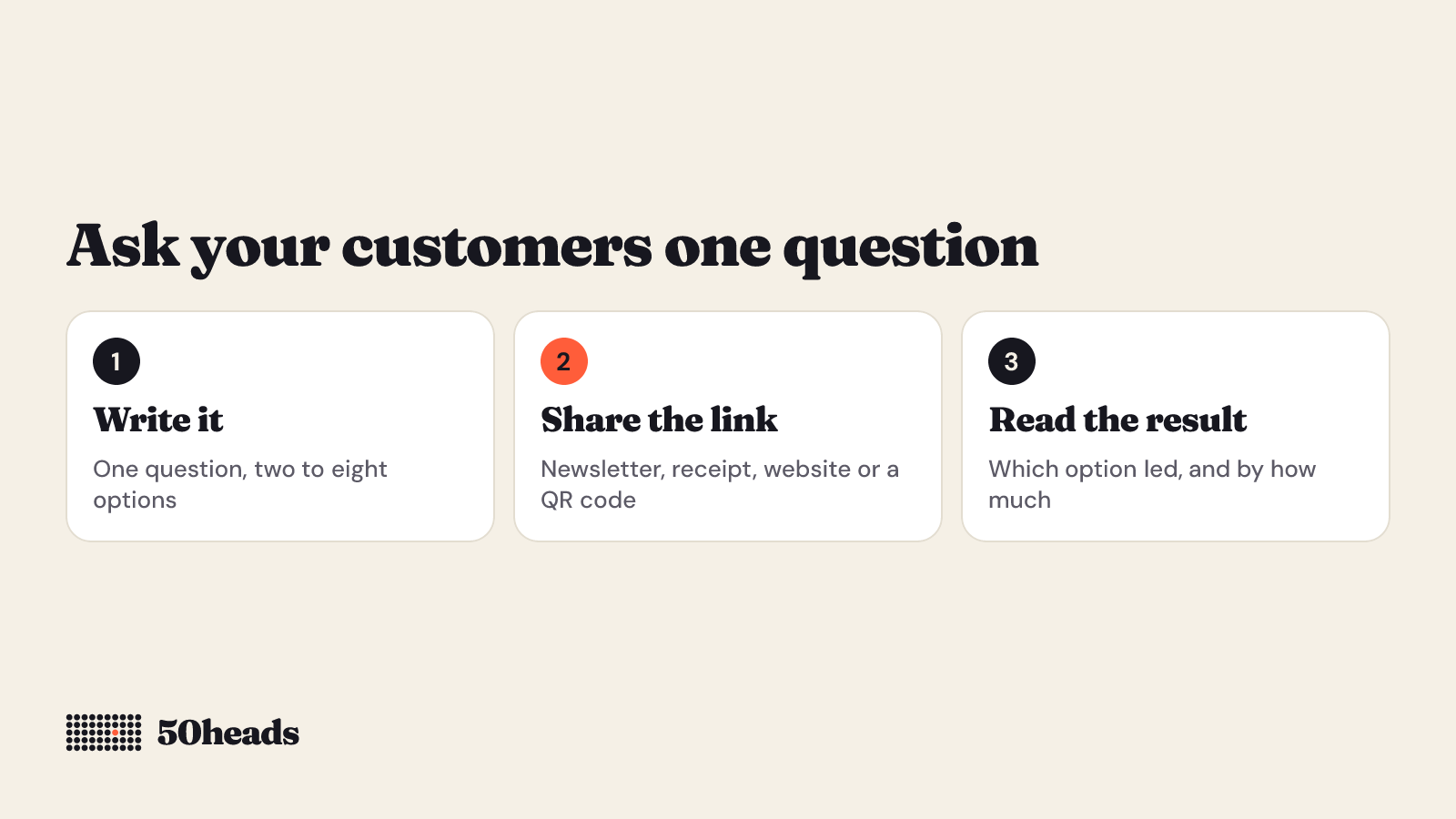
To ask your customers one question, write a single question with two to eight options, put it behind a link, and send that link wherever your customers already read: your newsletter, a receipt email, a WhatsApp group or your website. People tap an answer in the browser and are done. You get a count for each option and the margin between them, without building a form or asking anyone to sign up.
This works best when you have a real choice to make and the options already exist. If you need to understand why people feel something, or compare groups over time, you need more than one question. Our guide to poll vs survey covers where that line falls.
When one question to your own customers is the right tool
Ask the people you already know when their opinion is the one that matters:
- Your customers choose between versions of your own thing. Which of two menus, which delivery slot, which name for the new plan.
- Your readers decide what you write next. Which of three topics they want first.
- Your team settles a choice. Which of two logos goes on the stand, which date suits most people.
Ask strangers instead when the people you know would answer differently from the people you want to reach. Loyal customers like what you already do. If you are trying to win new customers, their opinion is not the whole picture. On 50heads you can ask heads, the people we verify, the same question and compare the two results side by side.
How to write the question
A one-question link lives or dies on the wording. Four rules cover most of it:
- Ask about one thing. "Which menu would make you order?" works. "Which menu is clearer and better value?" asks two things at once.
- Name the options plainly. Short labels people can tell apart at a glance. Use images when the choice is visual.
- Add "Neither" when it is a real answer. Forcing a choice between two options nobody likes tells you which one they dislike less, not which one they want.
- Don't lead. "Which of our exciting new flavours…" tells people what to think. "Which flavour would you try first?" does not.
Our guide to writing a question that does not lead goes into more detail, with examples.
How to share it so people answer
The link only gets answers where people already pay attention. The places that tend to work:
- Your newsletter or email list. One line and the link near the top, not at the bottom of a long email.
- A receipt or follow-up email. People who just bought from you are the ones whose answer you want.
- Your website. A short line on the page the question is about.
- A group chat or community. WhatsApp, Slack, Teams or a forum.
- In person. On 50heads, every link comes with a QR code you can print on a menu or a till.
Say what you will do with the answer, in one line. "We're choosing next month's special. Which would you order?" gets more answers than "Quick question".
What it costs
On 50heads, asking your own audience means choosing Your audience when you ask. The first 1,000 accepted answers each calendar month are free. After that, each accepted answer costs 5 credits. There is no tier, no charge for images and no account needed for the people answering.
When you publish, free answers are set aside first and credits are reserved only for the rest. Credits for answers you don't get come back when the link closes. See how Your audience works for the details.
What the answers can and cannot tell you
A one-question link shows what the people who chose to answer picked. That is useful, but it has two limits:
- The people who answered chose themselves. The ones who ignored the link may think differently. A strong lead among the people who answered is still a strong lead among them, and nothing more.
- Nobody is verified. 50heads blocks obvious repeats from the same browser and checks that each visitor is a person, not a script. It does not check who answered. Every result from a link says so.
If you need to know whether the result holds beyond your own audience, ask the same question to heads and compare. Our guide to what 50 answers can and cannot tell you explains how far a small sample goes.
A worked example
A café is choosing next month's lunch special and has two dishes ready.
- Write the question. "Which would you order for lunch next month?" with the two dishes as options and "Neither" as a third.
- Choose Your audience and set the link to stop at 150 answers and close after seven days.
- Share it. One line in the weekly email and a QR code on the counter.
- Read the result. Say the first dish got 61 answers, the second 34 and "Neither" 12. The result line says the first dish led by 25 points and how strong that lead is for 107 answers.
All 107 answers fell within the café's free answers for the month, so the question cost nothing. Past the free answers, each accepted answer would have cost 5 credits. The numbers in this example are made up to show how to read a result. They are not from a real study.
Next step
If you have a choice to make and people to ask, write it as one question and share the link. See how Your audience works, or check pricing first. The estimator shows the price before you ask and charges nothing.