To test packaging before you print it, show two designs to people who buy in your category, ask one question about one quality, and repeat for each quality that matters. Don't ask "Which do you prefer?" and stop there. Ask which stands out, which looks more trustworthy or which is clearer.
Printing the wrong design is expensive. A quick test is cheap.
Test one quality at a time
Packaging does several jobs. Each one is a separate question:
| Quality | Example question |
|---|---|
| Stand-out | Which pack would you notice first on a shelf of similar products? |
| Trust | Which pack looks like the more trustworthy brand? |
| Premium feel | Which pack looks more expensive? |
| Clarity | Which pack makes it clearer what is inside? |
| Fit | Which pack looks like it belongs in this category? |
A pack that wins on stand-out can lose on clarity. One overloaded question hides that.
A test sequence
- Start with stand-out. If nobody notices the pack, the other qualities matter less.
- Then ask about clarity. Can people tell what it is?
- Then the quality your brand depends on, such as trust or premium feel.
- Keep the winner. Compare it against the next design.
Each question goes to its own group of heads, the people who answer questions on 50heads. Don't treat the results as coming from the same people.
How to run each test
- Prepare two images. Use the same angle, background and size. A better photograph will beat a better design.
- Write one neutral question. See how to write a question that does not lead people.
- Use an A or B images question. People tap one of two pictures. Images add £0.07 an answer each, and the estimator shows the total before you ask.
- Add "Neither" if both could fail. It shows in grey in the results.
- Choose who answers. Target people who buy in the category. Each trait adds £0.03 an answer. Heads say these traits about themselves in the app, and we don't check them independently, except an age band set from an ID check.
- Ask fifty to start. Fifty Tier 1 answers to a short question cost £10.00 before images and typically take about ten minutes. Tier 1 means each person has a verified phone.
Test at phone size
Heads see your images on a phone. That is useful: a pack that reads well at that size will probably read well in a small online listing. It is also a limit. A phone screen doesn't show the feel of the material, the size on a shelf or the finish.
Use it to test what the design communicates. Don't use it to judge print quality.
A worked example
You have two designs for a fictional oat snack: one with a photograph of oats, one with a bold flat colour and a large name.
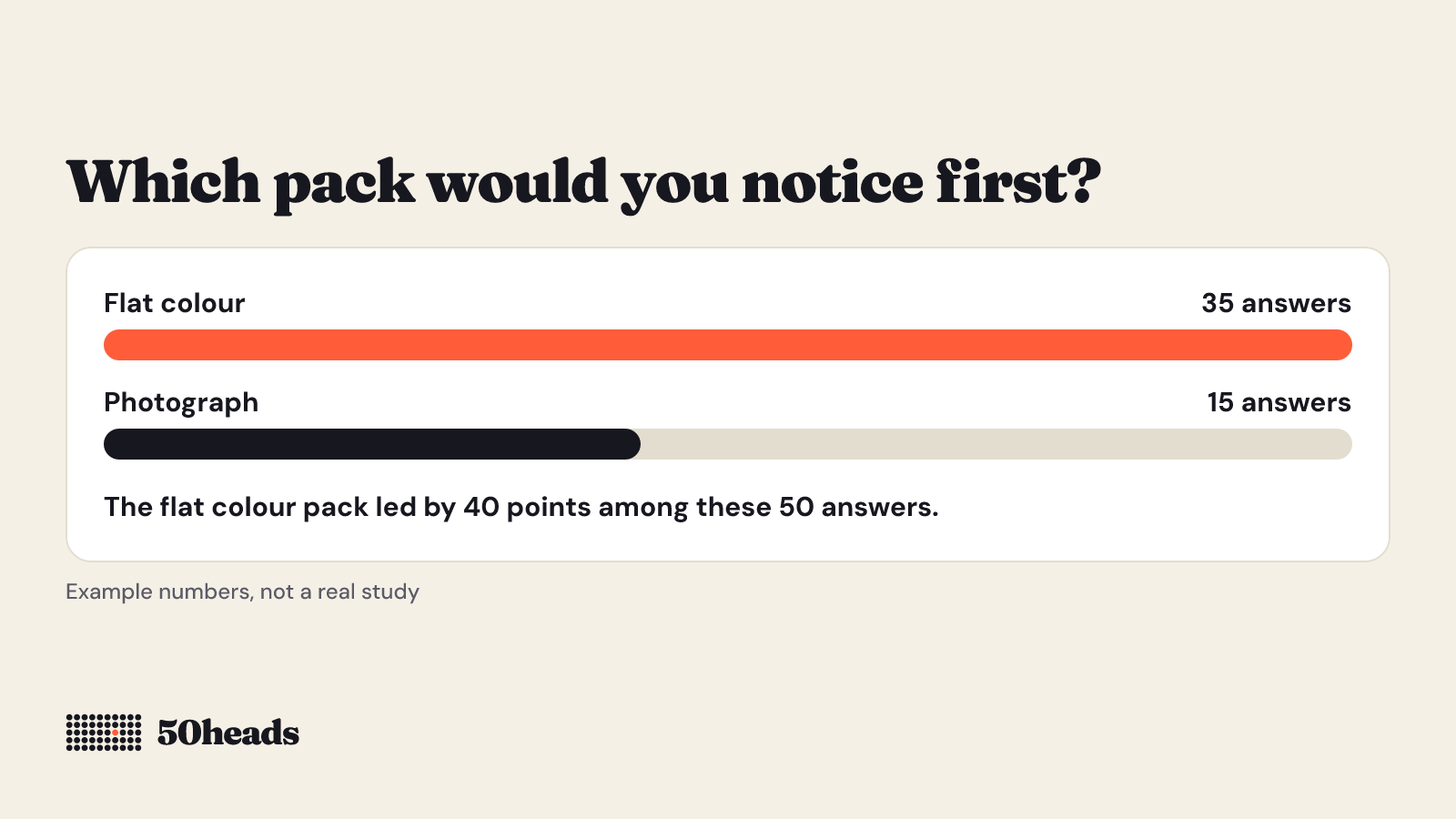
You ask fifty Tier 1 heads: "Which pack would you notice first on a shelf of similar products?" Say the result is the flat colour 35 and the photograph 15. The result line says the flat colour led by 40 percentage points among these 50 answers, and the lead is strong for a sample this size.
Then you ask a second group: "Which pack makes it clearer what is inside?" Say the photograph wins. You now know the bold pack stands out and the photograph explains. That may point to a design with both.
The numbers in this example are made up to show how to read a result. They are not from a real study.
What a packaging test does not tell you
- Whether people will buy it. Choosing a pack when asked is not buying.
- How it looks in a real shop. Lighting, neighbouring products and position all matter.
- How it feels. A screen shows no material or finish.
- Whether a different group would choose the same. The result shows what this group chose.
- Anything about real brands. Use your own designs, or fictional ones, never someone else's pack without permission.
Next step
Prepare two images and see the price first. See pricing and try the estimator. It charges nothing. For the method behind this, read what is preference testing.