To test ad creative before you spend on media, show two versions to people in your target audience, ask one question about one quality, and drop the weaker version. Ask about clarity, attention or trust, one at a time. Then run the survivors as live ads.
This removes obvious losers cheaply. It does not predict clicks or sales.
Why test before you spend
Every impression of a weak ad costs money. A live test also needs enough traffic to separate the winners, which takes time and budget.
A quick preference test with a small group costs a fraction of that. Use it as a first filter. See A/B testing vs preference testing for how the two fit together.
What to ask about
Pick one quality per question:
| Part of the ad | Example question |
|---|---|
| Image or thumbnail | Which image would you stop to look at? |
| Hook (the first line) | Which opening line makes you want to read on? |
| Clarity | Which ad makes it clearer what is being offered? |
| Trust | Which ad would you trust more? |
| Copy | Which line is clearer? |
Ask each as its own question. An ad can grab attention and still confuse. Each question goes to its own group of heads, the people who answer questions on 50heads, so the results come from different people.
How to run the test
- Prepare two versions. Change one thing between them, such as the image or the first line, so you know what drove the result. Use the same size and framing.
- Write one neutral question. See how to write a question that does not lead people.
- Use an A or B images question. People tap one of two pictures. Images add £0.07 an answer each, and the estimator shows the total before you ask. For text-only hooks, options can be up to 40 characters.
- Show it as it will appear. Heads answer on a phone, so a mobile ad should be tested at phone size. Small text that is clear on your desktop may not be on theirs.
- Choose who answers. Target the audience you will buy. Each trait adds £0.03 an answer.
- Ask fifty to start. Fifty Tier 1 answers to a short question cost £10.00 before images and typically take about ten minutes. Tier 1 means each person has a verified phone.
A worked example
You have two ad images for a savings app: a close-up of a coin jar and a phone screen showing a balance.
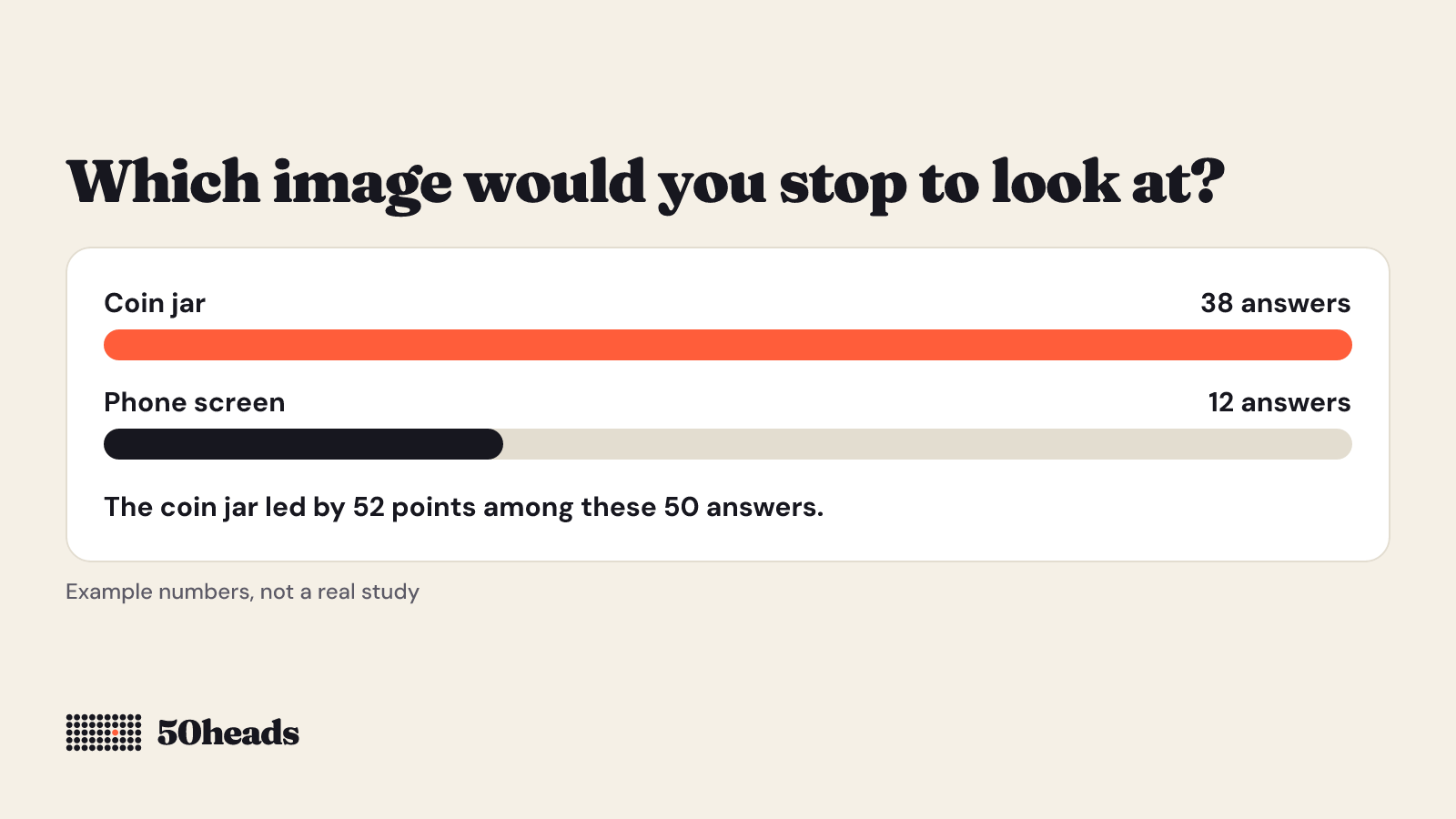
You ask fifty Tier 1 heads: "Which image would you stop to look at?" Say the coin jar gets 38 and the phone screen 12. The result line says the coin jar led by 52 percentage points among these 50 answers, and that the lead is strong for a sample this size.
You then ask a second group: "Which ad makes it clearer what is being offered?" The answer could differ. You may find the coin jar attracts attention and the phone screen explains the product. That points to combining them.
The numbers in this example are made up to show how to read a result. They are not from a real study.
What a quick test does not tell you
- Whether people will click or buy. Stating a choice is not behaviour.
- How the ad performs in the feed. Real ads sit among other content, at different times of day.
- How the platform will deliver it. Ad platforms choose who sees what.
- Whether a different group would choose the same. The result shows what this group chose.
- Anything about brands that are not yours. Test your own work, or fictional examples.
Next step
Prepare your two versions and see the price first. See pricing and try the estimator. It charges nothing. For the method behind this, read what is preference testing.