To test a product idea before you build it, put two to four concepts in front of people who match your customer, ask one question about one decision, and read the result as a direction. A quick test like this tells you which idea people picked. It doesn't tell you whether they will pay, or whether the product will succeed.
Be clear about which of those you are testing. They are different questions with different methods.
Four questions people mix up
| Question | What answers it |
|---|---|
| Which of these ideas do people pick? | A quick preference test |
| Does the problem matter to them? | Conversations with customers |
| Will they pay, and how much? | A price test, or real sales |
| Will it succeed in the market? | Launching it |
A quick test covers the first row. It is fast and cheap, which makes it good for narrowing choices early. It cannot cover the rest.
Choose the decision first
Don't start with "Is this a good idea?". Nobody can answer that in five seconds. Start with the decision you need to make this week:
- Which of three concepts do we prototype first?
- Which problem should the first version solve?
- Which description makes the product clearest?
If a result wouldn't change what you do, don't ask.
How to run the test
- Write each concept in a line or a picture. Keep every concept at the same level of detail and in the same style. A polished mock-up will beat a rough sentence, whatever the idea behind it.
- Write one neutral question. For example, "Which of these would you be most likely to use?" Describe, don't sell. See how to write a question that does not lead people.
- Pick the format. Options on 50heads can be up to 40 characters, so a short concept fits as text in a Pick one question. For anything longer, use a picture of each concept with an A or B images question, which takes exactly two. Images add £0.07 an answer each.
- Add "Neither" so people who want none of them can say so. It shows in grey in the results.
- Choose who answers. Target people like your customer, not everyone. Each trait adds £0.03 an answer, and countries cost nothing.
- Ask fifty to start. Fifty Tier 1 answers to a short question cost £10.00 and typically take about ten minutes. Tier 1 means each person has a verified phone. See how many people you need.
- Keep your questions together. In Projects, you can group questions by what you are trying to find out, so each round sits next to the last.
A worked example
You are choosing which of three ideas for a savings app to prototype first:
- Round up spare change
- Save towards a goal
- Split bills with housemates
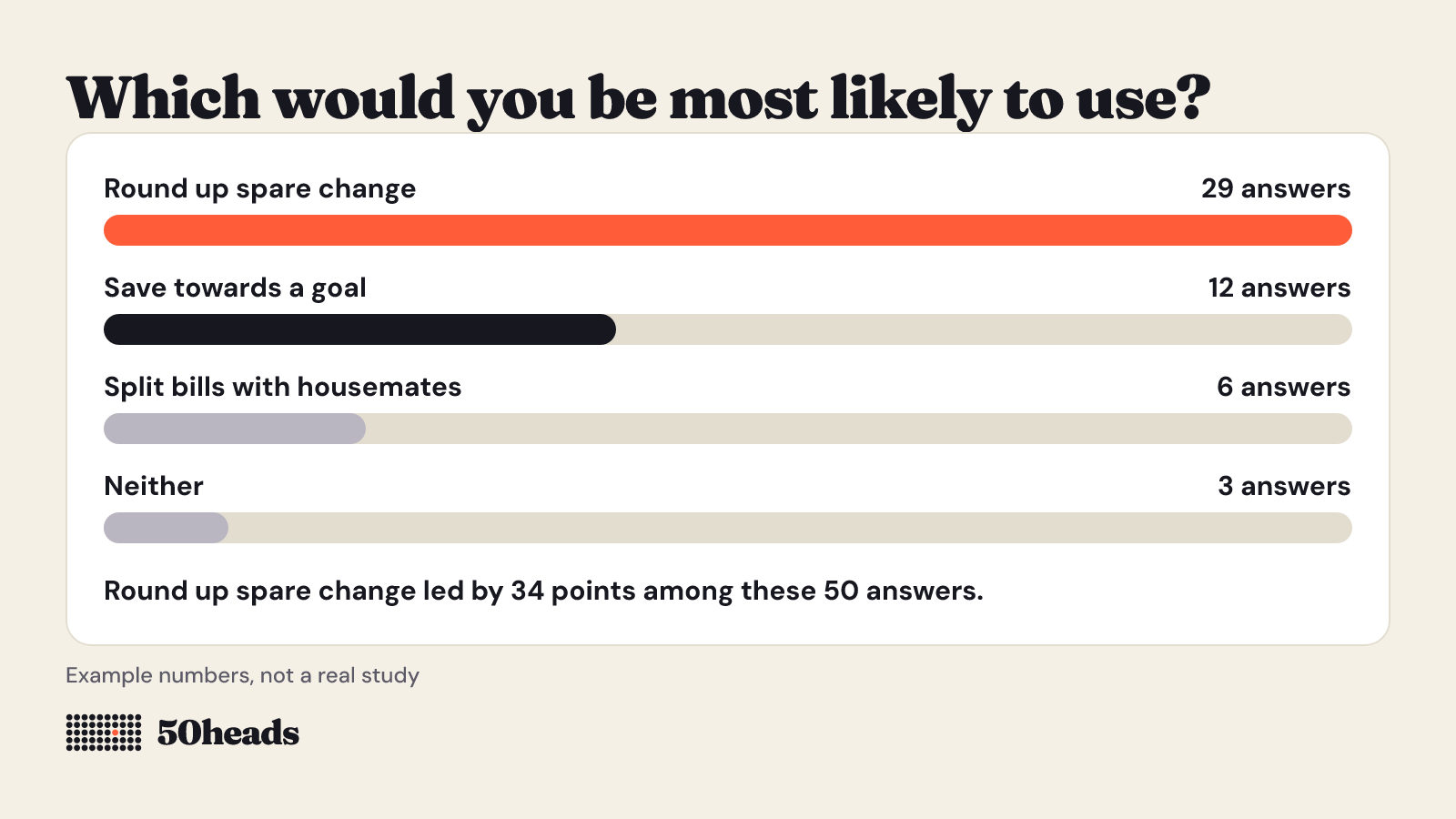
You ask fifty Tier 1 heads, the people who answer questions on 50heads: "Which of these would you be most likely to use?" Say the result is 29 for the spare-change idea, 12 for goals, 6 for bill-splitting and 3 for Neither. The result line says the spare-change idea led by 34 percentage points among these 50 answers and says how strong that lead is for a sample this size.
That tells you which idea this group picked. It does not tell you they would pay for it. For that, your next step is a different test, such as a price question or a landing page.
The numbers in this example are made up to show how to read a result. They are not from a real study.
Finding out why
Ask 20 Tier 2 heads, people who have also passed an ID check, for a short written reason (up to 200 characters). It often shows what drove a split.
What a quick test does not tell you
- Willingness to pay. Picking an idea is free. Paying is not.
- Whether the problem is real. Speak to customers for that.
- Whether you can build it well. A concept is easier to like than a product.
- Whether a different group would pick the same. The result shows what this group chose.
- Whether it will fit the market. Only launching shows that.
Next step
Write your concepts and see the price first. See pricing and try the estimator. It charges nothing. For the method behind this, read what is preference testing.