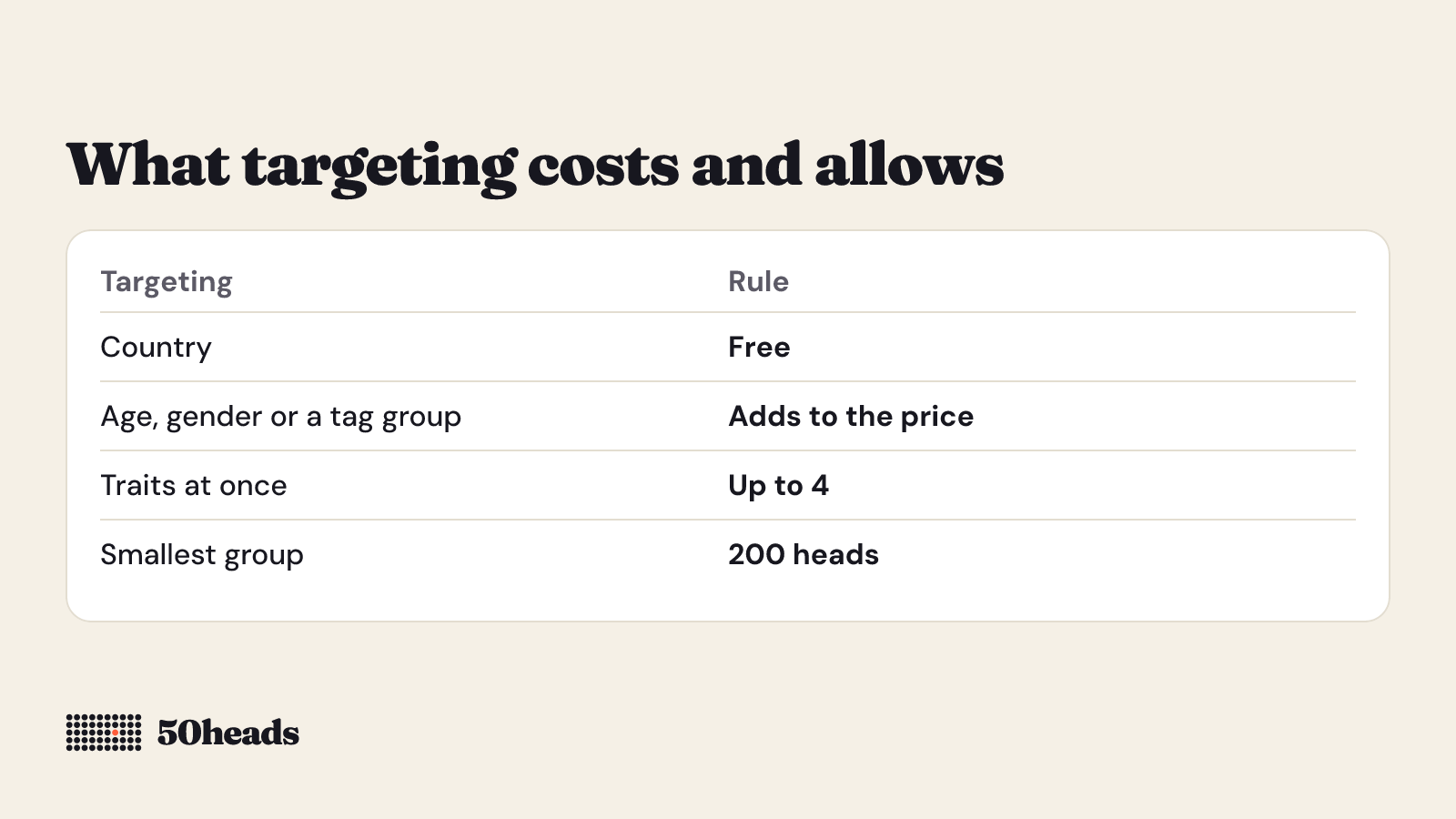
Target the smallest group that would change your decision. Each condition you add costs more and makes the question slower, because fewer people qualify. Start with a country. Add a trait only if people in that group would answer differently from everyone else.
Heads are the people who answer questions on 50heads. You choose who sees your question when you ask it.
What you can target
- Country. One or more. Countries are free.
- Age, gender and tags. Heads say these about themselves, optionally, in the app. There are about 120 tags in 12 groups, such as "parent of young children" or "plays console games".
- ID-checked age. At Tier 2 you can ask for ages taken from an ID check, rather than what heads declared.
Age, gender and each tag group count as one trait. You can combine up to 4. Every trait must match. Inside one trait, any value matches, so "dog owner or cat owner" is one trait.
What it costs
Each trait adds $0.05 an answer. Fifty Tier 1 answers cost $13 with no targeting. With two traits, such as women aged 25 to 34, they cost $17, which is $0.35 an answer.
The composer shows the price, how many heads match and how long it should take, next to the targeting, as you choose.
How to choose
Ask three things:
- Would this group answer differently? If parents of young children would pick a different pack than everyone else, target them. If not, don't.
- Is one trait enough? Try one before you add a second.
- Can the question be answered by anyone? Many first-impression questions don't need targeting.
Over-targeting
Every condition shrinks the pool. A small pool takes longer, and a question may close before it fills. If fewer heads answer than you asked for, you pay only for the answers you get, and the result shows how many answered.
Targets smaller than 200 heads are refused. That means no group is small enough to identify anyone.
An example
You are testing a children's snack. You could ask everyone, or only parents of young children.
- Ask everyone first: "Which pack looks tastier?"
- If you think parents would choose differently, add one trait: the parent tag.
- Compare the two results.
If both groups pick the same pack, you didn't need the extra trait. If they differ, you have learned something. For how to test the packs themselves, see how to test packaging. For how many people to ask in each group, see how many people you need.
What targeting does not do
- It is not verified. Traits are what heads say about themselves. We don't check them independently, except an age band set from an ID check.
- It does not make a small sample representative. Fifty answers from a targeted group show what those people chose.
- It does not split results freely. Results can be broken down by country, tier, age band and gender, but only for groups of 5 or more answers.
- Nothing about a head's age or gender is shown with an answer.
Saving an audience
If you ask the same group often, set who answers in the composer and save it as an audience at the foot of that card. Then use it in a new question.
Next step
Choose a country first, then see what an extra trait costs. See pricing and use the estimator. It charges nothing. For the rules, read targeting by country, age, gender and tag.