To test a product name, pick the one quality that matters, write one neutral question about it, and ask a group of people to choose between two to eight names. Avoid "Which do you like?". Ask what you actually need to know, such as which name they would trust, remember or expect to do a particular job.
The answer changes with the question. That is the point of testing.
Start with the job the name has to do
A name does different jobs in different places. Decide which one you are testing:
- Trust. Would you hand over money or data to a company with this name?
- Fit. Does the name suit what the product does?
- Memorability. Would you remember it tomorrow?
- Clarity. Can you guess what it is from the name?
- First impression. What do you think of it, with no other context?
Test one at a time. A name can win on trust and lose on memorability.
How the question changes the result
Suppose you have three names for a savings app: Northway, Keel and Brightpot.
| Question | What it measures |
|---|---|
| Which name would you trust with your savings? | Trust |
| Which name suggests a savings app? | Fit |
| Which name would you remember? | Memorability |
| Which name do you like most? | A general reaction |
Each can give a different leader. "Which do you like?" is the weakest, because it doesn't match a decision. People can like a name they would never trust.
How to run the test
- Shortlist two to eight names. Fewer is easier to read.
- Pick the criterion from the list above.
- Write one neutral question. For example, "Which name would you trust with your savings?" Don't add praise such as "great" or "new". See how to write a question that does not lead people.
- Keep each name short. Options on 50heads can be up to 40 characters. Show the name alone, not a slogan.
- Add "Neither" if it is a real possibility. It appears last and shows in gray in the results.
- Choose who answers. If the name is for a particular group, such as parents or a single country, target them. Each targeting trait adds €0.05 an answer. Countries cost nothing.
- Choose how many. Fifty is a reasonable start. See how many people you need.
A worked example
You ask fifty Tier 1 heads: "Which name would you trust with your savings?" Heads are the people who answer questions on 50heads, and Tier 1 means each has a verified phone. The options are Northway, Keel, Brightpot and Neither. Fifty Tier 1 answers to a short question cost €12 and typically take about ten minutes.
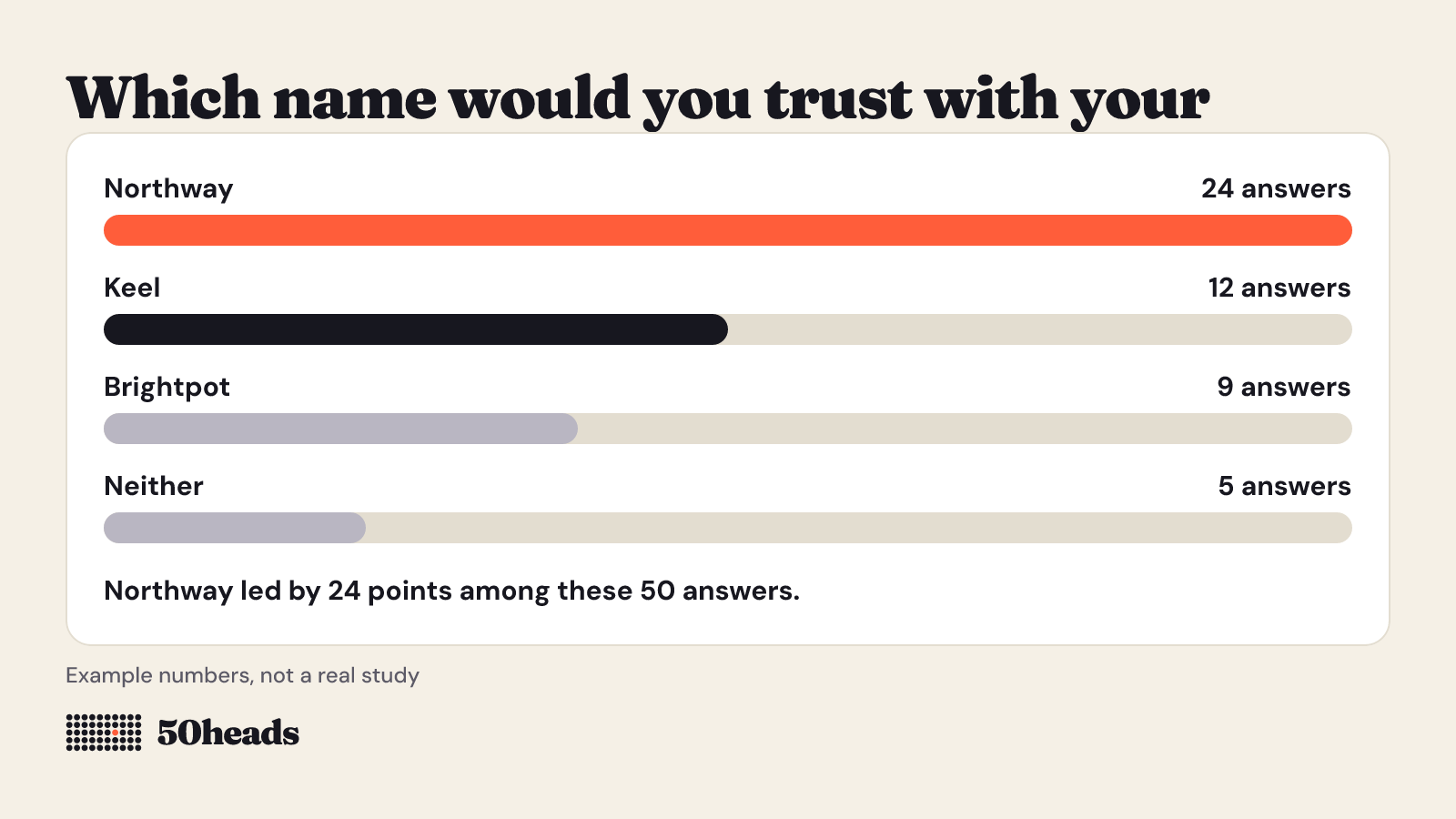
Say the result is Northway 24, Keel 12, Brightpot 9, Neither 5. The result line says Northway led Keel by 24 percentage points among these 50 answers, then says how strong that lead is for a sample this size.
You then run a second question on the same shortlist: "Which name would you remember?" That goes to a new group of heads, so you can compare the two results but not the same people.
The numbers in this example are made up to show how to read a result. They are not from a real study.
Finding out why
A split tells you what, not why. If one name wins and you don't know what drove it, ask 20 Tier 2 heads, people who have also passed an ID check, for a short written reason. Free text is up to 200 characters.
What a name test does not tell you
- Whether the name is available. Check trademarks and domains separately.
- Whether the name works in other languages. Ask in each language, as every question is asked in one.
- Whether it will sell. Choosing a name when asked is not buying.
- Whether it works with your logo and product. A name is seen alongside other things.
- Whether a different group would agree. The result shows what this group chose.
Next step
Write your shortlist as one question and see the price first. See pricing and try the estimator. It charges nothing. For the method behind this, read what is preference testing.