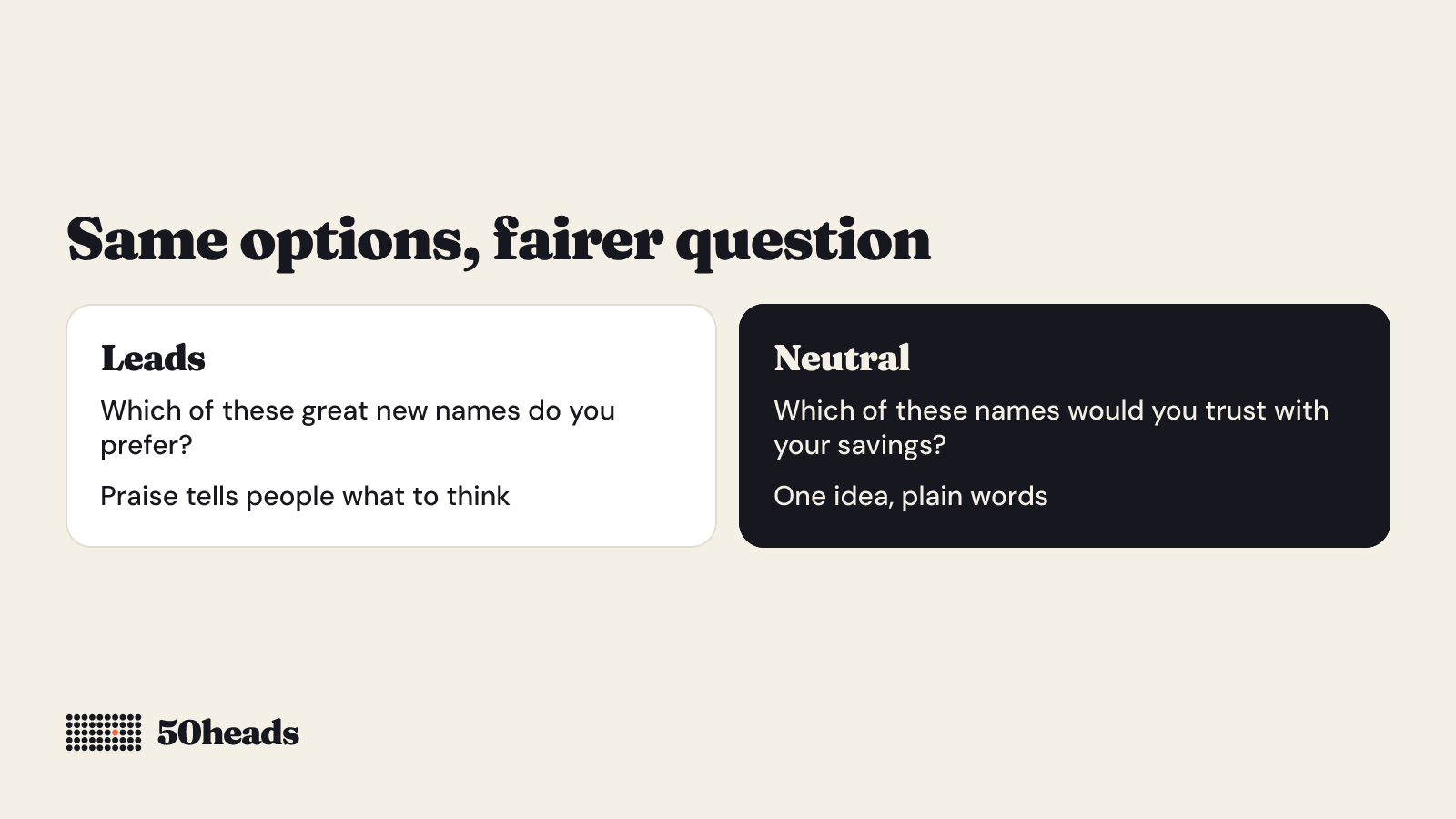
A leading question tells people what answer you want. To avoid that, ask one thing, describe the options without praising any of them, and don't hide an assumption in the wording. Read your question as someone who has never heard of your idea.
Why it matters
A leading question can produce a strong result for the wrong thing. The answers may be clear and still tell you nothing, because the wording did the choosing.
A strong lead means the answers favoured one option. It doesn't mean your question was fair.
Five ways a question leads
1. Praise in the wording
Before: Which of these great new names do you prefer?
After: Which of these names would you trust with your savings?
"Great new" tells people what to think. Describe the choice instead.
2. A hidden assumption
Before: How much do you enjoy our fast delivery?
After: Which delivery time would you choose? Same day · Next day · Within 3 days
The first question assumes people enjoy it and that it is fast. The second asks for a choice.
3. Two ideas in one question
Before: Which logo is more modern and trustworthy?
After: Which logo looks more trustworthy?
Two ideas give you an answer to neither. If you care about both, ask two questions.
4. Options that are not equal
Before: Which would you pick? A short, clear headline · A long headline full of jargon about our platform capabilities
After: Which headline is clearer? Headline A · Headline B
If one option is obviously weaker, the result tells you nothing. Make each option a serious candidate, written in the same style.
5. Missing options
Before: Which would you buy? Plan A · Plan B
After: Which would you buy? Plan A · Plan B · Neither
If "neither" is a real possibility, include it. Otherwise people who like neither are forced to pick one.
A checklist before you ask
- One idea. Could someone agree with half of it?
- Plain words. No jargon, no abbreviations, no internal names.
- No praise. Remove "great", "new", "leading", "powerful".
- Equal options. Same length, same style, same effort to read.
- Behavior, not opinion about others. "Which would you order?" beats "Which is more popular?"
- Short. On 50heads, up to 150 characters to read costs the base price. Longer questions cost more and tend to get less clear answers.
Check it on a phone
Heads, the people who answer questions on 50heads, answer on a phone in about five seconds. The composer shows your question exactly as they will see it. If it doesn't fit on the screen without scrolling, cut it.
What a neutral question still can't do
A fair question gives you a fair read of what this group chose. It doesn't tell you why. It doesn't show that the winner is best. And a different group might choose differently.
If you need the reasons, ask a follow-up. On 50heads, you can ask 20 Tier 2 heads, people who have passed an ID check, for a short written reason.
Next step
Take the question you were about to ask and run it through the checklist. Then see pricing and check the estimate. It charges nothing. The full rules are in writing questions that get clear answers. For the method behind it, read what is preference testing.